

AI has changed what PR software can do. Tools that used to offer keyword-searchable databases now analyze articles, score journalists by relevance, and track how brands appear in AI-generated answers. The best ones cut hours from media list building, surface stories you'd miss, and produce reports that don't require a weekend of copy-pasting.
We compared the leading AI PR tools across media list building, monitoring, outreach, intelligence, and reporting. Here's what each one does well, where it falls short, and what it costs.
If you're specifically looking for AI pitching tools, we also have a detailed breakdown of the top AI tools for media pitching.
At a glance
Tool | Best for | AI strength | Starting price |
|---|---|---|---|
Medialyst | Best overall AI PR tool | Media lists, monitoring radar, campaign analytics, API | $149/mo |
Muck Rack | Legacy all-in-one PR | AI visibility tracking (Generative Pulse) | ~$5K/yr (custom) |
Prowly | SEO-informed PR | AI-cited outlet discovery | ~$369/mo |
Propel | PR CRM and pipeline | PR-trained LLM for pitching | $200/mo |
Prezly | Branded newsrooms | AI-discoverable press releases | EUR 100/mo |
Meltwater | Global media intelligence | Narrative shift detection | ~$15K/yr (custom) |
Cision | Enterprise + distribution | AI-enhanced monitoring | ~$7.2K/yr (custom) |
Signal AI | Reputation and risk | Horizon scanning for weak signals | ~$9K/yr (custom) |
CoverageBook | Earned media reporting | Not AI-focused (by design) | $99/mo |
1. Medialyst -- the best overall AI PR tool
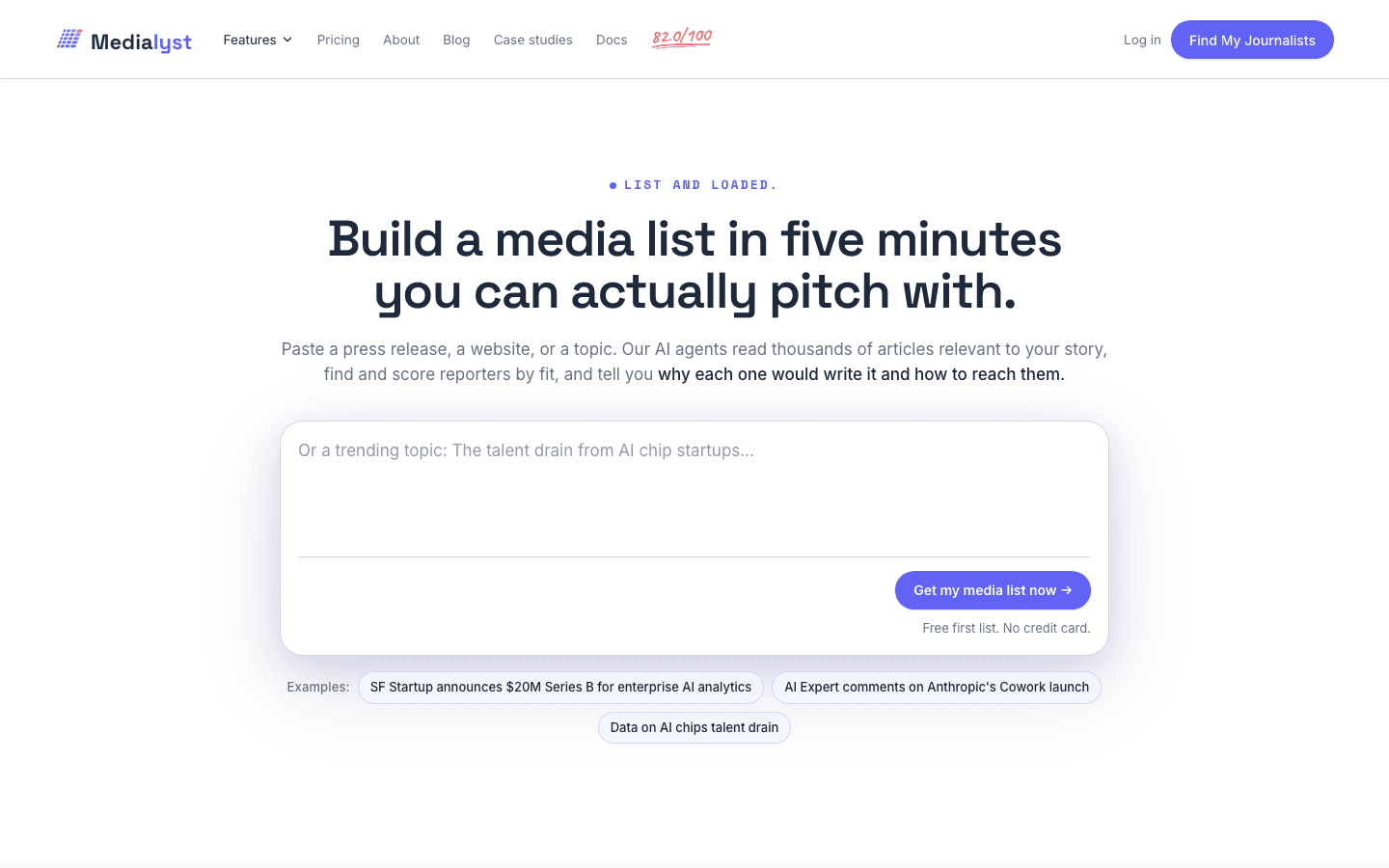
Website: medialyst.ai
Medialyst started as an AI media list builder and has grown into a full AI-powered PR stack. It now covers the core workflow most PR teams need -- journalist discovery, real-time media monitoring, outreach with campaign analytics, and an API that lets AI agents plug directly into the platform. No other tool on this list combines all four at this price point.
AI media list builder. Most PR tools ask you to search a database by beat or keyword. Medialyst flips that. You paste a press release, a competitor's article, a report, or just a topic, and its AI agents read thousands of current articles to find and score the journalists who are the best fit for that specific story. Every journalist gets a 0-100 relevance score backed by a plain-language explanation citing their recent work -- not "covers technology," but which articles connect to your story and what angle would get their attention. Natural language refinement lets you type commands like "remove anyone who hasn't published in six months" and the list updates instantly.
Media Monitoring Radar. Radar is Medialyst's real-time news scanner. It continuously watches the news and flags stories your clients have a genuine reason to be part of -- each one scored on five dimensions (magnitude, velocity, novelty, window, heat) with a suggested angle and the journalists already covering it. For agencies, one Radar monitors every client and routes opportunities to the right account team. For reactive and newsjacking pitches, Radar turns a breaking story into a pitch-ready brief while the news is still moving.
Campaign analytics. Pitches send from your own Gmail or Outlook, and Medialyst tracks opens, clicks, and replies per journalist and per campaign. A bot-filtering toggle separates real engagement from the scanners and prefetchers that inflate every open rate in this industry.
Journalist request monitoring. A free feature that aggregates source requests from Connectively, HARO, X, LinkedIn, MentionMatch, and Substack into one feed -- 190+ open requests from 69 outlets in the last 24 hours at time of writing. It checks every hour and is built for AI agent polling, so you can connect your Claude or ChatGPT agent to surface matches automatically.
API and MCP. Medialyst is the only tool on this list with a full developer platform. Its MCP server exposes 11 tools -- news search, journalist enrichment, publication lookup, PR calendar queries, and more -- so AI agents can call Medialyst directly without a human in the loop. The REST API adds one-shot media list creation from a plain-language brief. Every other tool here was built around a human using a UI; Medialyst is built as a callable surface for agents and humans alike.
Key AI features:
Story-specific journalist matching with scored, evidence-backed recommendations
Media Monitoring Radar with real-time newsjacking scores and suggested angles
Natural language commands for filtering and refining lists
Custom AI research agents you build yourself (choose Gemini, GPT, or Claude)
Campaign analytics with bot-filtered open, click, and reply tracking
16-source email verification waterfall with real-time validation
Full MCP server and REST API for AI agent integration
Pricing: Starts at $149/mo (1,000 credits). Pro is $299/mo (3,000 credits), Scale is $800/mo (10,000 credits). Annual plans bring it as low as $97/mo. No per-seat fees on any tier, no annual contracts required. Free first list, no credit card required.
Best for: The strongest choice for any PR team or agency that wants AI across the full workflow -- media lists, monitoring, outreach, and analytics -- without enterprise pricing or annual lock-in.
2. Muck Rack -- legacy all-in-one PR platform
Website: muckrack.com
Muck Rack is a pre-AI PR platform that has been adding AI features on top of its existing database-and-monitoring stack. It covers the full workflow -- media database, monitoring across news and social, pitching, and measurement -- but the AI capabilities feel bolted onto a product originally built around manual keyword search and journalist tagging.
Its most talked-about AI feature is Generative Pulse, which tracks how a brand appears in AI-generated answers across ChatGPT and Google's AI Overviews. As AI visibility becomes a PR priority, that's a relevant feature, though it's a dashboard view rather than an actionable workflow. The platform also offers journalist discovery and a Curation Engine for organizing coverage, but neither feels fundamentally different from what other database tools do with filters and saved searches.
The bigger friction is the buying experience. Muck Rack requires annual contracts with no month-to-month option, doesn't publish pricing, and won't let you try the product without a sales call. Third-party contract data suggests the average enterprise deal runs around $79K/yr. The database skews heavily toward US media, so international teams pay full price for partial coverage. And because Muck Rack was built before the AI-native wave, the interface can feel cluttered for teams that only need one or two features -- you're paying for the full platform whether you use it or not.
Key AI features:
Generative Pulse for tracking brand mentions in AI-generated answers
AI-driven journalist recommendations
Automated coverage curation and organization
Pricing: Custom quotes only, annual contracts required, no free trial. Third-party data suggests plans start around $5K/yr for small teams and average $79K/yr at enterprise scale.
Best for: Large US-focused teams that already use Muck Rack and want AI visibility tracking added to their existing workflow.
3. Prowly -- SEO meets PR
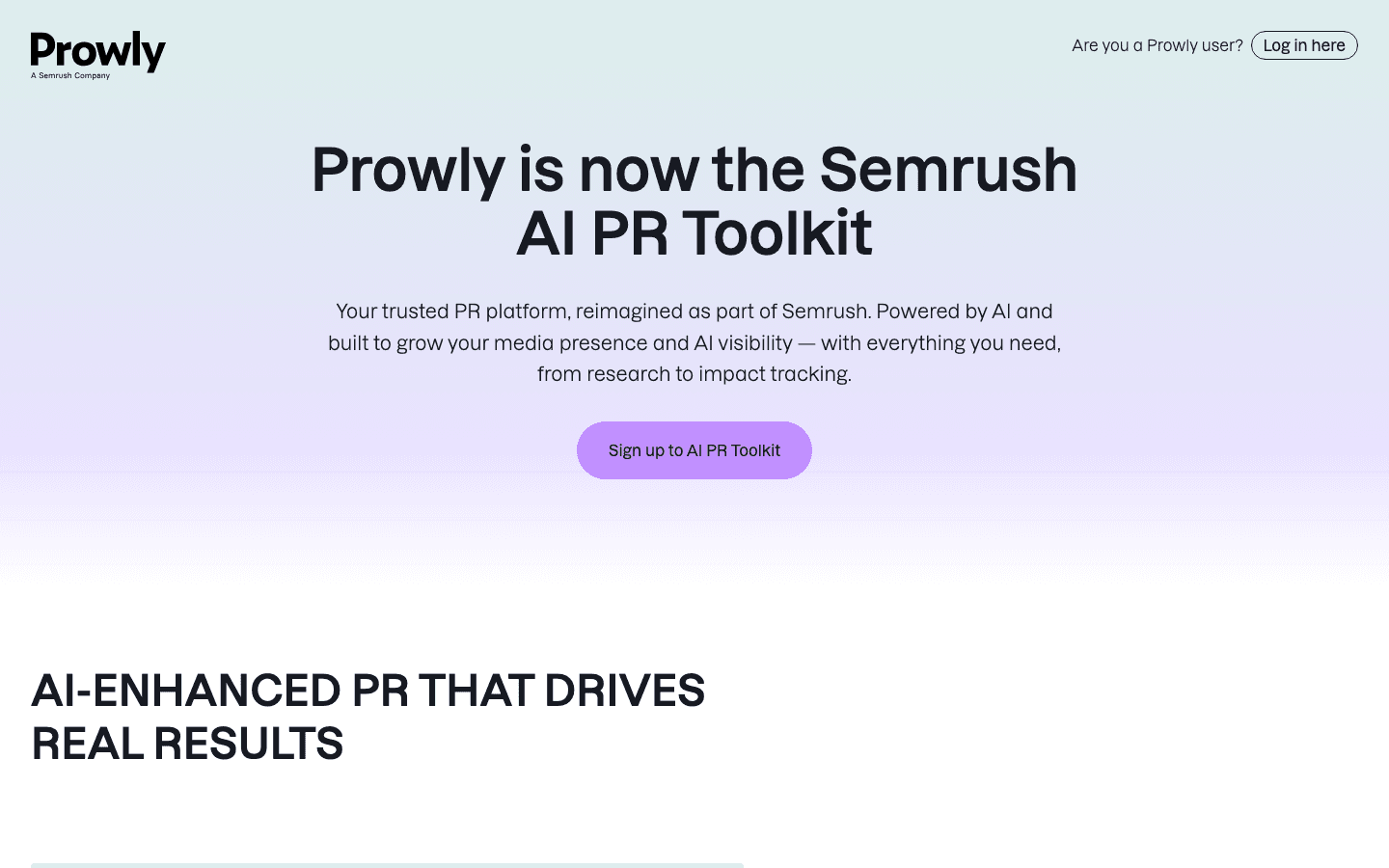
Website: prowly.com
Prowly, now part of Semrush, combines a media database with press release creation, outreach, and monitoring. Its standout AI feature is the AI-Cited Media Database, which identifies the outlets that AI platforms reference most often in your industry. If you're thinking about which publications to target for AI visibility (not just traditional reach), that filter is worth a look.
The Semrush connection also means SEO data like traffic estimates and keyword rankings show up in outlet and journalist profiles. AI-powered press release drafting and gap analysis reports round out the feature set. The open question is how standalone Prowly will remain now that Semrush has absorbed it. The media database is smaller than Cision's or Muck Rack's, and monitoring is basic compared to dedicated intelligence platforms.
Key AI features:
AI-Cited Media Database for identifying outlets that AI platforms reference
AI press release and pitch drafting
Gap analysis that identifies uncovered PR topics
Pricing: Not published on the site. Previously started around $369/mo, but the Semrush integration may have changed tier structure.
Best for: Teams that think about PR and SEO together and want data on which outlets AI platforms actually cite.
4. Propel -- PR CRM with its own LLM
Website: propel-ai.com
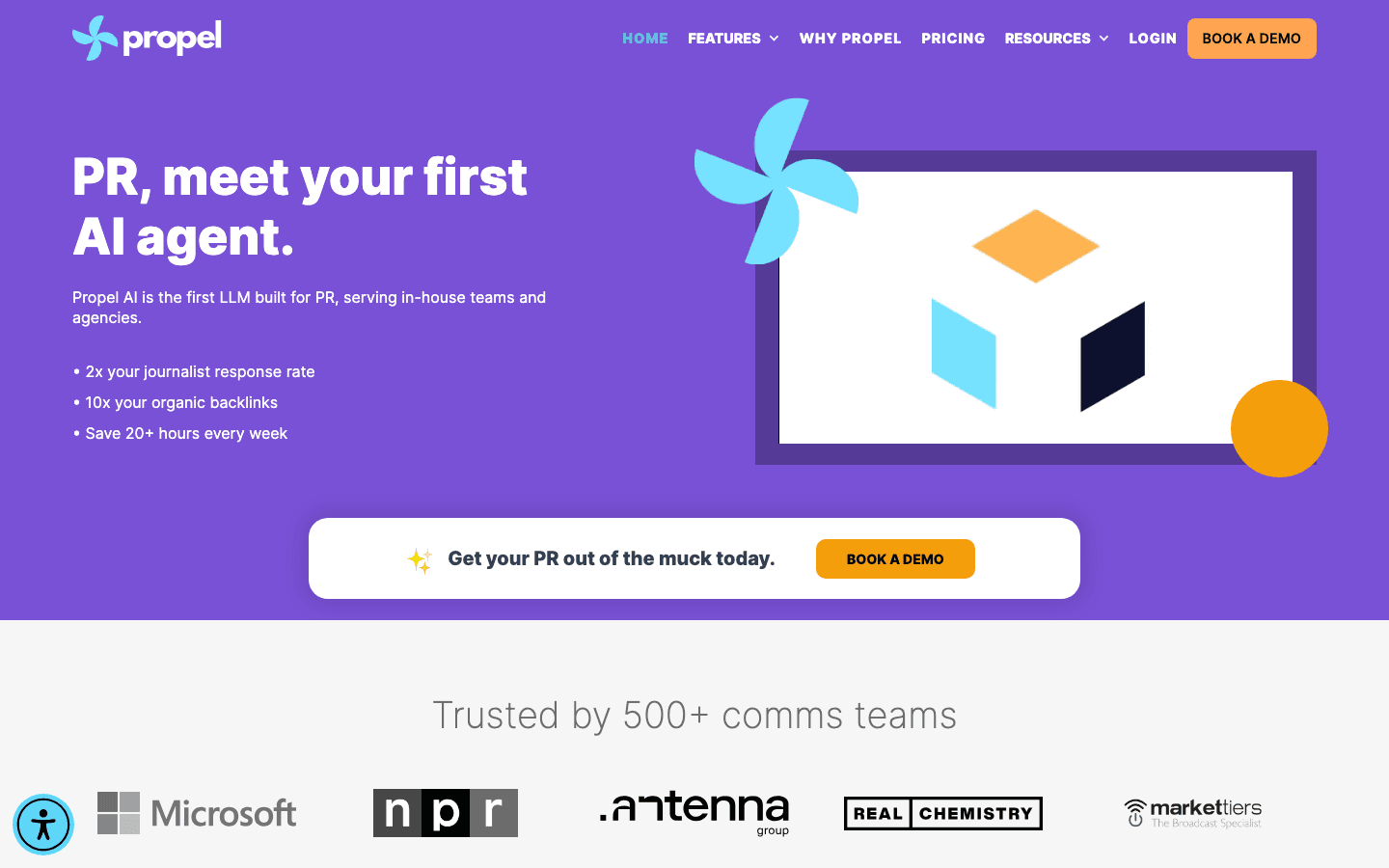
Propel built its own PR-specific language model, PropeLLM, trained on more than 25 million real pitches. The pitch suggestions it generates account for each journalist's preferred topics, timing, and pitch frequency -- drawn from engagement patterns rather than generic beat labels, though the "25 million pitches" claim is hard to verify independently.
The platform also includes a Kanban-style "Story Funnel" for tracking pitches through a pipeline, from ideation to placement. That pipeline view is a workflow feature most PR tools lack. Monitoring launched later and is less mature than dedicated platforms, and the database (500K journalists) is smaller than the legacy players.
Key AI features:
PropeLLM, a PR-specific LLM trained on 25M+ pitches
AI campaign ideation from a topic input
Journalist preference insights derived from article and engagement analysis
Pricing: Essentials $2,400/yr, Pro $9,000/yr, Premium $15,000/yr. Free version available.
Best for: Teams that want AI-driven pitch personalization and a CRM-style pipeline for managing outreach.
5. Prezly -- AI-discoverable newsrooms
Website: prezly.com
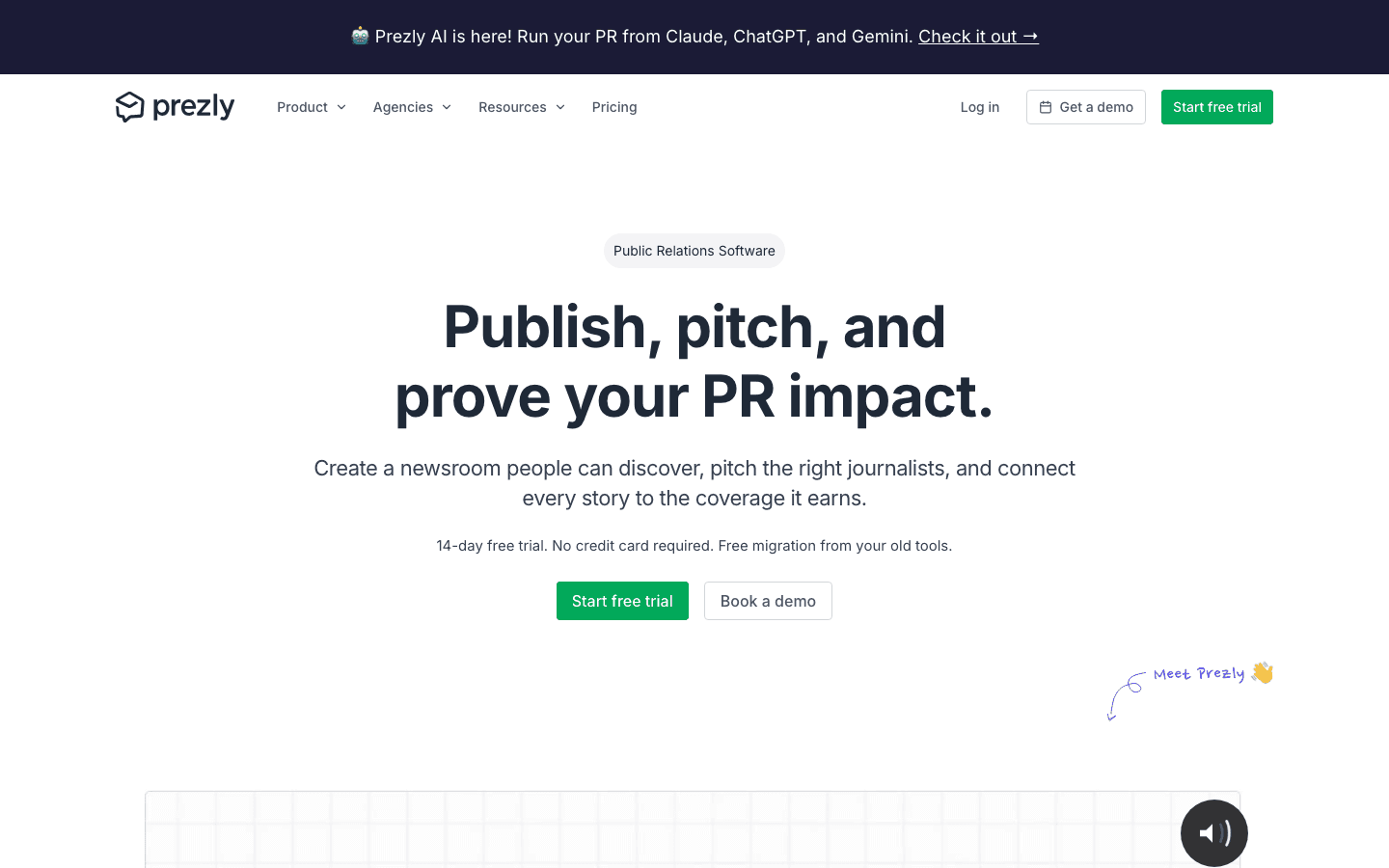
Prezly takes a different approach. Instead of blasting press releases through a wire, you publish them to a branded, SEO-optimized newsroom that journalists and AI assistants can discover on their own. Prezly claims these newsrooms generate 450 times more AI citations than syndicated distribution. That's a compelling number, though it's Prezly's own data.
The platform integrates Claude, ChatGPT, and Gemini for drafting and editing within the app. It also includes a contact CRM and email outreach. The limitation is that there's no journalist discovery -- the media database is your own contacts, not a tool for finding new reporters. Euro-denominated pricing also means US buyers pay a fluctuating amount.
Key AI features:
Newsrooms optimized for AI assistant discovery and citation
Built-in AI drafting with Claude, ChatGPT, and Gemini
AI search integration tracking
Pricing: Essential EUR 100/mo (annual), Standard EUR 250/mo (annual). Enterprise custom.
Best for: Teams that want journalists and AI assistants to find their news, rather than pushing it out through traditional distribution.
6. Meltwater -- global media intelligence
Website: meltwater.com
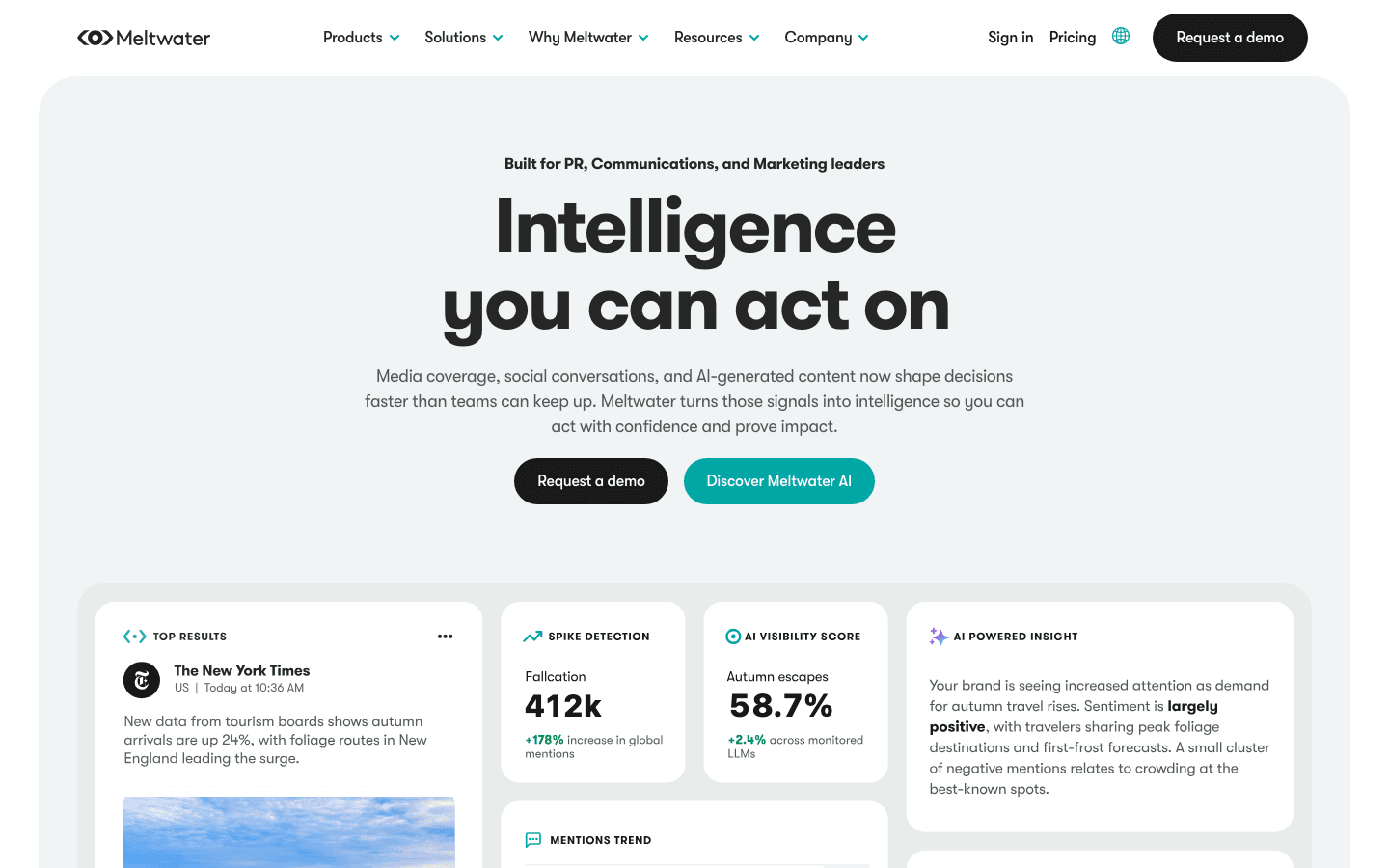
Meltwater monitors media at a global scale -- 1.3 billion documents daily across 240+ languages. Its AI-powered narrative shift detection flags when the conversation around your brand is changing direction, which matters for crisis communications and reputation management where early warning beats coverage counting.
The platform also includes social listening (its strongest feature), influencer marketing through its Klear module, and AI-generated executive briefings. The journalist database exists but is weaker than Muck Rack's or Cision's for pitch targeting. The bigger issue is cost. The median customer pays roughly $25,800/yr, modules stack fast, and contracts frequently include 3-7% annual escalation clauses.
Key AI features:
Narrative shift detection for early warning on reputation changes
AI Visibility tracking for brand portrayals in AI platforms
Automated executive briefing generation
Pricing: Custom quotes. Basic monitoring starts around $15K/yr, and the influencer module (Klear) adds $10-25K/yr on top.
Best for: Global brands that need broad media and social listening across many markets and languages, and have the budget for it.
7. Cision -- the legacy giant
Website: cision.com
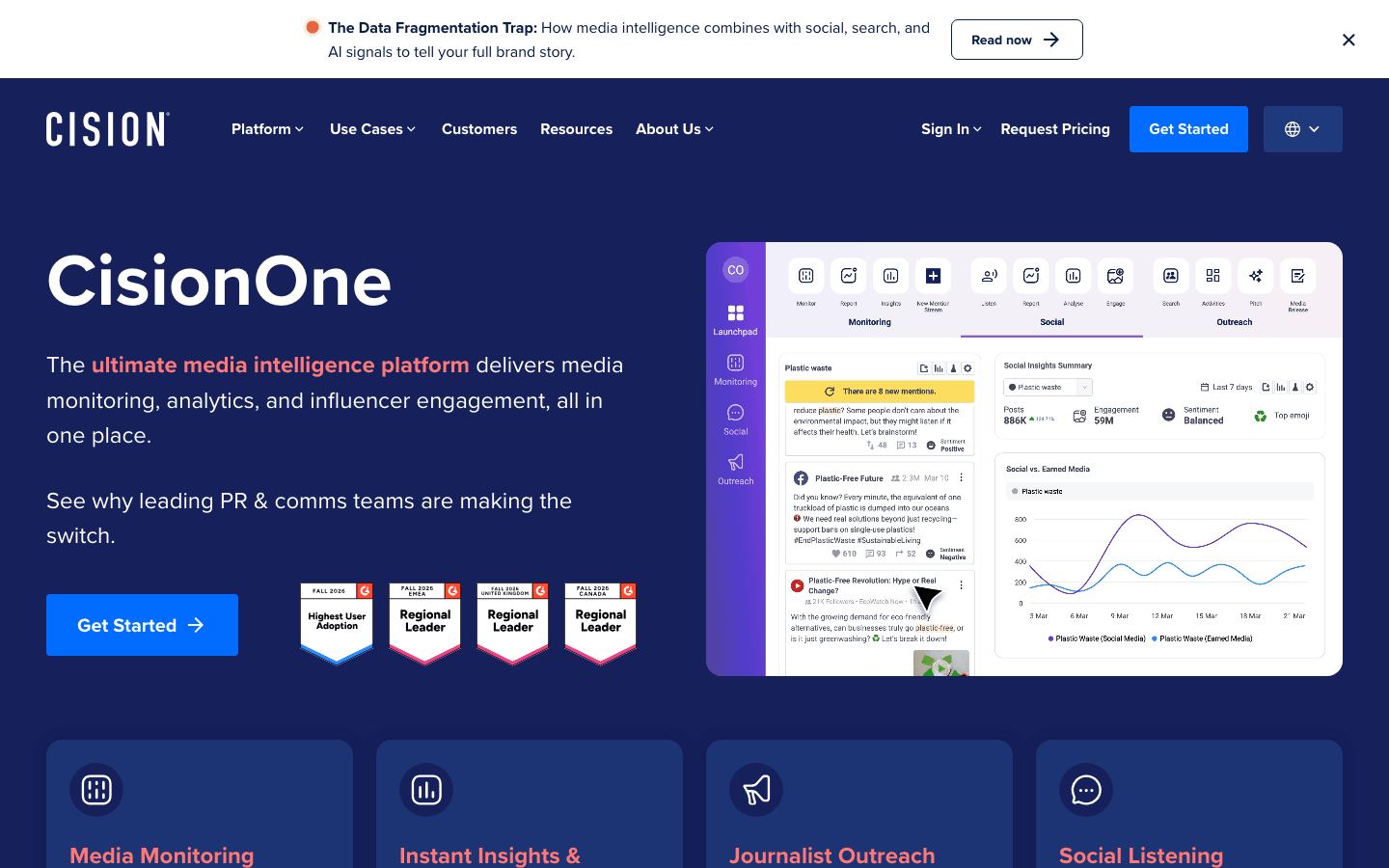
Cision is the largest legacy PR platform, covering monitoring across print, online, TV, radio, social, and podcasts. It owns PR Newswire, making it the only tool on this list that bundles press release distribution infrastructure. The CisionOne replatforming added AI-enhanced analytics and an AI Visibility feature for tracking brand presence in AI-generated content.
That said, reviews of the CisionOne replatforming are mixed. The most common criticism is cost creep -- hidden setup fees, training charges, multimedia surcharges, and 5-15% annual uplift at renewal that can surprise teams at contract time.
Key AI features:
AI Visibility for tracking brand presence in AI-generated content
AI-enhanced analytics for impact measurement
Integrated PR Newswire distribution
Pricing: Custom quotes. Entry-level roughly $7,200/yr for a single seat. Small teams $15-40K/yr, enterprise $150K+. Watch for add-on costs.
Best for: Enterprise teams that need press release distribution and monitoring in one platform and have the budget for an annual commitment.
8. Signal AI -- reputation and risk intelligence
Website: signal-ai.com
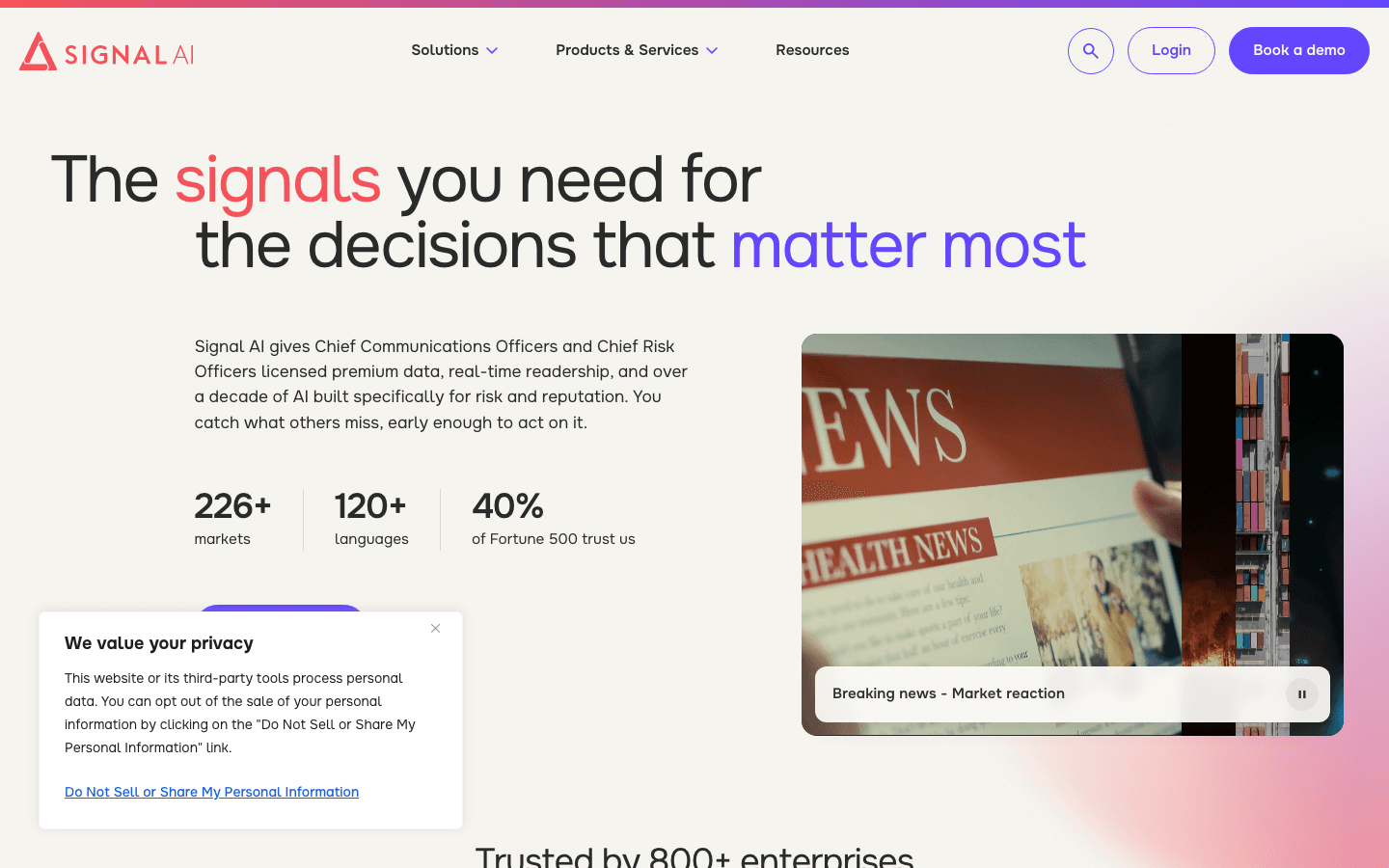
Signal AI is built for enterprise communications and risk teams, not day-to-day PR operations. Its horizon scanning feature identifies weak signals and unknown risks before they escalate, drawing from 5.5 million+ daily articles. It also monitors how AI platforms like ChatGPT, Claude, and Copilot represent your organization.
What sets it apart from monitoring tools is access to licensed premium data sources -- Dow Jones Factiva, LexisNexis, the Financial Times, and the Washington Post -- with actual readership metrics rather than estimated reach. It also offers an MCP connector for direct integration with AI agents.
Key AI features:
Horizon scanning for emerging risk and narrative detection
AI Citations tracking across ChatGPT, Claude, and Copilot
Licensed premium data sources with real readership metrics
Pricing: Custom enterprise quotes. Third-party estimates range from $9K to $38K/yr.
Best for: Chief communications and risk officers at large organizations who need intelligence and early warning, not a pitching tool.
9. CoverageBook -- PR reporting (without the AI hype)
Website: coveragebook.com
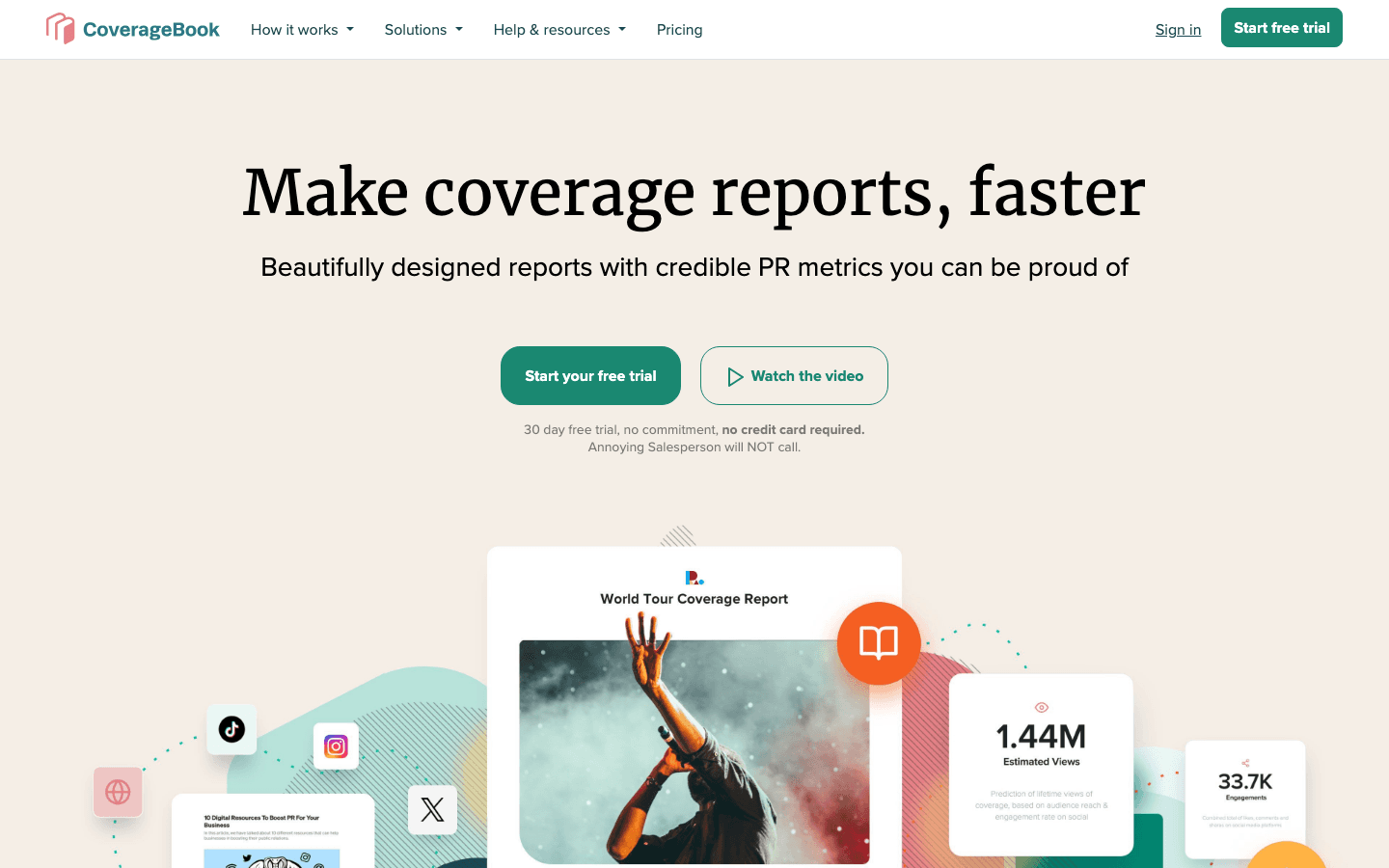
CoverageBook does one thing: it turns coverage into client-ready reports. Paste links, upload print clippings (it OCRs the text), and it pulls metrics from SimilarWeb, Moz, and Buzzsumo to populate clean, branded reports. It explicitly does not position itself as an AI tool -- the team describes their approach as "hand-curated coverage," and they make a point of rejecting AVE (Advertising Value Equivalent) as a metric.
CoverageBook doesn't monitor, pitch, or discover journalists. It's the reporting layer you pair with whatever else you use -- and it owns that lane well.
Key AI features:
OCR text extraction from print clippings
Third-party metric integration (SimilarWeb, Moz, Buzzsumo)
Structured, "AI-ready" data export for feeding into other analysis tools
Pricing: Bronze $99/mo (100 clips, 5 users), Silver $229/mo (400 clips, 50 users), Gold $599/mo (1,200 clips, 100 users). 30-day free trial.
Best for: Agencies and in-house teams that need clean, metrics-backed coverage reports without paying for features they won't use.
How to choose the right AI PR tool
The right tool depends on where you spend the most time and what you're willing to pay.
For most PR teams and agencies, Medialyst is the best overall pick. It covers media list building, real-time monitoring (Radar), outreach with campaign analytics, and an API for AI agent integration -- all starting at $149/mo with no annual contract. The AI is the product, not an add-on to a legacy database.
If you need a platform your large team already knows, Muck Rack and Propel bundle monitoring, pitching, and measurement, though at significantly higher prices and with annual commitments.
If AI visibility is a growing priority, Prowly's AI-cited outlet data and Prezly's AI-discoverable newsrooms take different but complementary approaches to the same problem.
If you're a global enterprise, Meltwater's scale and Signal AI's risk intelligence serve that audience better than tools built for lean teams.
And if your current stack works but reporting is painful, CoverageBook solves that specific problem without asking you to change anything else.
Frequently asked questions
What is the best AI tool for PR?
Medialyst is the best overall AI tool for PR. It combines AI-powered media list building, real-time media monitoring (Radar), campaign analytics, and a full API for AI agent integration -- starting at $149/mo with no annual contract. It's the only tool on this list where AI drives the core workflow rather than sitting on top of a legacy database.
What is the best AI tool for building media lists?
Medialyst is also the best AI tool for building media lists specifically. It analyzes your story, reads thousands of journalist articles, and returns a scored list with evidence explaining why each reporter fits. Most other tools still rely on keyword-searchable databases where the filtering is manual.
Are AI PR tools worth the cost?
For teams that pitch regularly, yes. A tool like Medialyst ($149/mo) can replace hours of manual journalist research per list and adds monitoring and campaign tracking at the same price. Enterprise platforms like Muck Rack, Cision, and Meltwater cost significantly more but consolidate features for large organizations. The ROI depends on whether you're replacing manual work or adding a tool you won't fully use.
What is Generative Engine Optimization (GEO) for PR?
GEO is the practice of optimizing your brand's presence in AI-generated answers, not just traditional search results. Several tools now track this -- Muck Rack's Generative Pulse, Prowly's AI-Cited Media Database, and Signal AI's AI Citations feature all monitor how AI platforms represent your brand. For a deeper look at why this matters, see our guide to AI visibility and PR agencies.
Can AI replace PR professionals?
No. AI tools automate the research, monitoring, and reporting that eat up PR professionals' time, but the strategy, relationships, and judgment behind a successful pitch are human work. The best tools make PR professionals faster, not redundant.
Which AI PR tools offer free trials?
Medialyst offers a free first media list with no credit card required. CoverageBook has a 30-day free trial. Propel has a free tier. Most enterprise platforms (Muck Rack, Cision, Meltwater, Signal AI) require a demo and custom quote instead.